


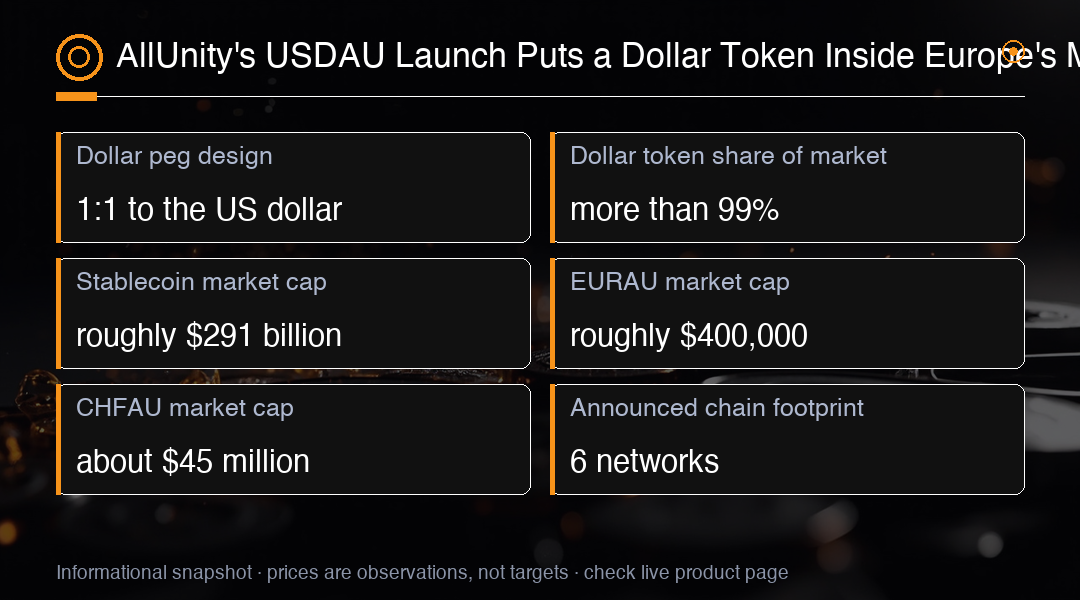
AllUnity, a European stablecoin issuer operating under the European Union's Markets in Crypto-Assets framework, announced this week that it is launching USDAU, a US dollar-pegged token that the issuer describes as MiCAR-compliant. AllUnity says USDAU is designed to maintain a 1:1 peg to the US dollar through segregated US dollar reserves. It is the fourth fiat-backed token from the same issuer, following the euro, Swiss franc and Swedish krona tokens already in circulation.
The announced footprint is six networks: Ethereum, Solana, Base, Tempo, Arc and Polygon. That breadth matters for distribution, because a token deployed on more chains is easier for treasury teams to reach without bridging every payment. But the technical deployment footprint is not the same thing as a liquid, accessible market on each chain. Exchange listings, on-chain depth, wallet support, bridge routes and geographic availability are chain-specific, and no chain-by-chain detail was provided at launch. Read the deployment as an announced technical distribution, not a running order book.
Access to the primary market is also narrower than the token's chain count suggests. Contemporaneous launch coverage states that eligible institutional clients which complete onboarding can mint and redeem USDAU at par through AllUnity's Business Mint Account. That is a gated institutional channel, not open redemption for every holder on every network. A secondary-market buyer is buying from another holder, and inherits that holder's exit options rather than a direct par redemption right.
On reserves, the honest position is narrow. AllUnity states that USDAU is backed by segregated US dollar reserves. The materials reviewed do not disclose the composition of those reserves, the name of any custodian, the legal mechanics of segregation, the audit or attestation provider, the reporting frequency, or the current reserve ratio. A stated 1:1 peg and a described reserve structure are issuer design claims, not independent proof of real-time backing or permanent parity. Until a reserve report appears, the peg is a stated intention with a regulatory frame around it.
The euro side of the franchise gives a sense of the starting scale. CoinGecko measured EURAU at roughly $400,000 in market capitalization and CHFAU at about $45 million at the time of the launch. Those are dated third-party estimates, and market capitalization is not the same as settlement volume, adoption, available liquidity or redemption capacity. The gap between those euro franc figures and the dollar-pegged market is the more useful signal for anyone reading crypto market structure: the dollar-denominated side of the industry operates at a scale the euro-denominated side has not approached.
The dollar side dominates. Dollar-pegged tokens account for more than 99% of a roughly $291 billion stablecoin market by capitalization, on CoinGecko data reported at the time of publication. Sector totals, supply classification and provider methodology all move continuously, so that figure is a snapshot with a date attached rather than a fixed industry constant. Even so, a new European issuance arriving in a dollar-dominated sector is a market-structure data point rather than a disruptive one, and the share statistic is the reason it matters more than the launch itself.
The policy tension is explicit. The European Central Bank warned in June that greater use of dollar stablecoins in European tokenised finance could deepen dependence on the US dollar and weaken the euro's international role. The underlying central bank publication was not independently retrieved during this review, so the exact wording and date of the warning remain unconfirmed. The strategic question, whether European on-chain finance settles more in dollars or more in euros, is nonetheless now being answered by issuers rather than by regulators alone.
MiCAR compliance should be read precisely. Being issued inside the European framework means the token operates under a defined authorisation and disclosure regime. It does not mean the token is EU-backed, government-guaranteed, deposit-insured, legal tender, or equivalent to a bank deposit. Issuer, operational, legal, liquidity, market and counterparty risk all remain with the holder. A regulatory wrapper narrows the perimeter of what is permitted; it does not remove risk, and it does not convert a token into a bank liability.
Business positioning is also ahead of the evidence. AllUnity positions USDAU for regulated corporate payments, global settlement, treasury management and cross-border dollar activity, and its chief executive frames the launch as dollar liquidity brought inside Europe's regulatory perimeter. No reviewed source documents post-launch transaction volume, customer uptake, exchange depth or realised revenue. The business case is currently an intention with a regulatory label attached, which is a normal state for a new issuance and not a reason to assume either success or failure.
For traders, the tradeable angle is the structure rather than the token. USDAU is a small new issuance entering a sector that dollar tokens already dominate on the measure that matters most, which is capitalisation. What the launch signals is that regulated European issuers expect durable demand for dollar-denominated settlement inside Europe. If that pattern repeats across issuers, European on-chain finance inherits more dollar invoicing habits, which is precisely the outcome the ECB flagged when it raised the currency question.
The items that would convert this from a policy data point into a measurable flow picture are concrete: reserve attestations from the issuer, exchange listings with visible depth, business accounts actually minting, and additional MiCAR-authorised issuers following with dollar-denominated tokens. Until one or more of those appear, USDAU remains an announcement with a peg, a chain list and a business-use narrative. Watching for the disclosure is more useful than trading the headline, because disclosure is what converts a claim into something a market can price.
The net read for market structure is modest but real. A European issuer has put a dollar token inside a regulated wrapper, on six chains, aimed at institutional settlement, while the euro question raised by policymakers stays unresolved. Dollar settlement rails are being extended in Europe rather than replaced, and the competitive question is whether a regulated euro-denominated alternative can hold the same institutional use cases. Until disclosure, depth and volume arrive, the launch belongs in the structural column rather than the price action column, and the euro-versus-dollar settlement debate gains one more data point instead of a conclusion.
Trading Insight
Watch sector structure rather than the token: dollar-pegged supply growth, whether other MiCAR issuers add dollar tokens, and any reserve attestation, exchange depth or business minting from AllUnity. A new issuance moves nothing in crypto price action on its own, so express the view through the deepest liquid crypto proxy, and size for the fact that announcement-day attention fades within days.