


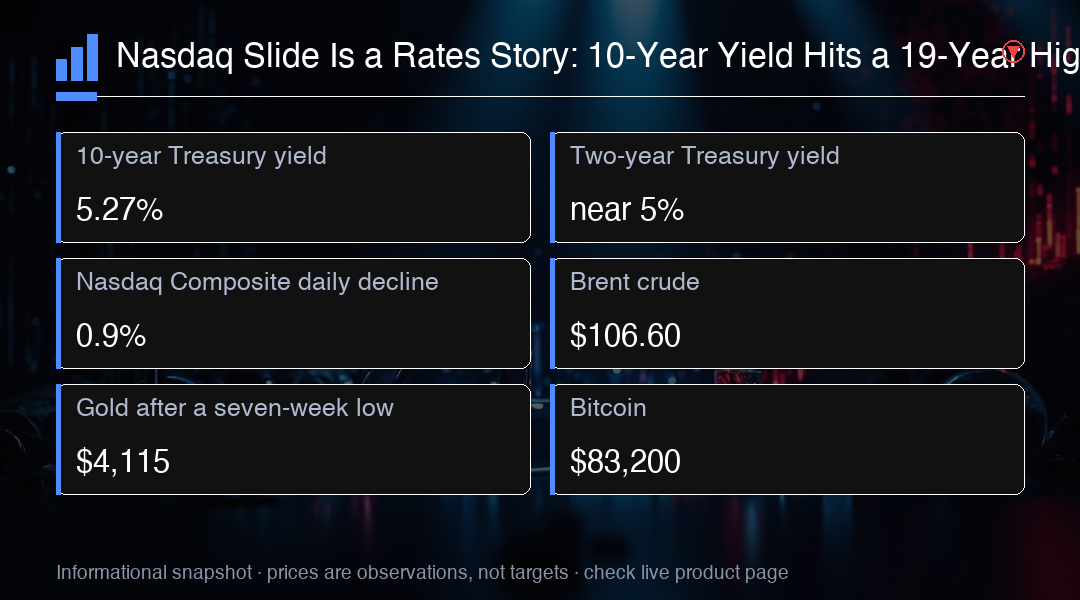
The Nasdaq Composite fell 0.9% on Monday, a 0.92% slide on the session and the weakest performance among the three major US gauges. The S&P 500 lost 0.8% and the Dow dropped 0.7%. That ordering matters. When all three indexes fall but the most rate-sensitive one falls hardest, the culprit is rarely earnings. It is the price of money, and this week the price of money moved a long way.
The 10-year Treasury yield climbed above 5.27%, its highest level in 19 years, while the two-year yield approached 5%. Markets now anticipate three more Federal Reserve hikes by mid-2027, a path that was not the base case a few months ago. Higher yields raise the discount rate applied to every future dollar of earnings, and long-duration technology valuations carry more of that cash flow than almost anything else on the tape. Monday's decline was that arithmetic being marked to market in a single session.
Oil is the reason the rate path changed. Brent crude traded around $106.60 on Tuesday with no breakthrough in negotiations between Washington and Tehran, and oil has stayed above $106. Expensive energy feeds straight into transport, manufacturing and wage decisions, which is how a supply shock turns into a persistent inflation problem. A central bank looking through that would be arguing against a lot of evidence, so the market did not argue with it. It priced the tightening instead.
Nvidia was the day's counterweight, gaining nearly 2% after expanding its share-repurchase program by a record $150 billion, taking available capacity to approximately $235 billion through fiscal 2028. For a company sitting on that much cash, the buyback is the cleanest signal it can send about its own valuation. It was also not enough. The announcement limited the Nasdaq's decline rather than reversing it, which tells you how firm the bond market's grip was on the day.
The damage outside Nvidia was more direct. Intel fell 5.7%, Sandisk lost 3.7% and Meta dropped 4.8%. MongoDB plunged more than 18% after its chief executive departed for a role at Meta, reporting to Mark Zuckerberg. A single personnel headline removed a fifth of a software company's value in one session, which is a useful reminder of what a low rate environment had been doing for valuation multiples. Cheap capital let key-person risk sit quietly inside the price. Higher yields bring it back into the open.
Asia passed the same problem along overnight. Equities mostly declined as bond yields rose in Japan, South Korea and Australia, and China's main onshore index stayed near a one-year low. Reports that Washington may prohibit Chinese components from US data centers added another layer to a supply chain that already treats AI hardware as a strategic asset. That report is unconfirmed, and the market is treating it as a headline risk rather than a settled policy, but the direction of travel is clear enough for traders to keep the risk premium in Chinese hardware names.
The dollar is heading for a monthly gain, and the crosses show it. EUR/USD traded near $1.1367, USD/JPY held around 157.30 and AUD/USD stood near $0.7012 ahead of the Reserve Bank of Australia's decision. An RBA increase is fully priced, so the hike itself carries little information. The guidance attached to it does not. For a market already repricing global rate paths, a central bank that holds the line against firm domestic demand is telling traders something the policy rate alone does not.
Gold stabilized around $4,115 after tumbling approximately 4% to a seven-week low, and Bitcoin traded near $83,200 after briefly slipping below $83,000. Both are reported here as market context rather than as a direction call. What they show is a single macro force running through every asset: higher real yields. Gold's 4% drop came with the 10-year at its highest level in 19 years, and Bitcoin's dip below $83,000 happened in the same window. The former $82,000 support still matters, because the difference between an orderly pullback and a failed breakout is usually one well-held level.
The calendar now takes over. US job openings arrive Tuesday and give the week its first meaningful read on labor demand. PCE inflation follows Wednesday, ISM manufacturing lands Thursday and nonfarm payrolls close the week on Friday. Economists expect approximately 85,000 new jobs and unemployment around 4.1%. That is a soft-looking setup on the surface, which is precisely why the reaction function matters more than the headline number this week.
The scenarios run in both directions. A strong job openings reading could push yields higher by reinforcing the case for additional Fed tightening. Hot inflation or firm employment would pressure rate-sensitive technology shares, the same ones that led Monday's decline. Soft numbers could give the Nasdaq room to recover, since a labor market cooling alongside sticky energy prices is the one combination that relieves the discount rate without reviving the growth scare. Nobody knows which one arrives until the data does, and the whole sector is positioned as though it will be the strong one.
Micron reports fiscal fourth-quarter results Wednesday after the close, with options implying a move of roughly 7% in either direction. That figure reflects how investors have priced the event, not a forecast of where the stock lands. The numbers that matter are gross profit, capital expenditure and high-bandwidth-memory demand, because those three lines determine whether AI infrastructure earnings can keep compounding quickly enough to justify the valuations the whole complex is carrying. At current yields, the market is asking for more growth, not less.
The desk takeaway is narrow. The Nasdaq is trading as a rates instrument this week, and every catalyst on the calendar feeds the same variable. Watch the 10-year above 5.27% and the two-year near 5% as the resistance pair for the equity story: sustained pressure there keeps Monday's decline intact, while a retreat in yields gives the index something to trade back toward. Nvidia's $235 billion of buyback capacity through fiscal 2028 is a floor under sentiment, not a catalyst for it. Until the labor and inflation data land, the bond market is setting the price for everything downstream.
Trading Insight
MC Markets reads the current Nasdaq weakness as a discount-rate event rather than an earnings event, and that distinction matters for how the index behaves this week. With the 10-year yield above 5.27% and three more Fed hikes priced by mid-2027, the Nasdaq Composite is effectively trading the bond market's view of the path ahead. The cleanest level to track is the yield pair: if the 10-year holds above its 19-year high while the two-year stays near 5%, the conditions that produced Monday's 0.9% decline stay in place. Softer labor and inflation readings could relieve that pressure and give the index room to recover, while firm data would keep the discount rate elevated. Monday also showed the downside is not uniform. Nvidia's record $150 billion buyback expansion, lifting capacity to approximately $235 billion through fiscal 2028, limited the index loss but did not reverse it, while MongoDB's 18% drop on a personnel headline illustrated how quickly key-person risk reprices when capital is no longer cheap. For traders, that argues for treating Nasdaq exposure as a macro position through this week's data rather than a stock-picking exercise, and for watching Micron's post-close report Wednesday, where options price a move of roughly 7% in either direction. This is an observation of how the index is trading, not a recommendation.